
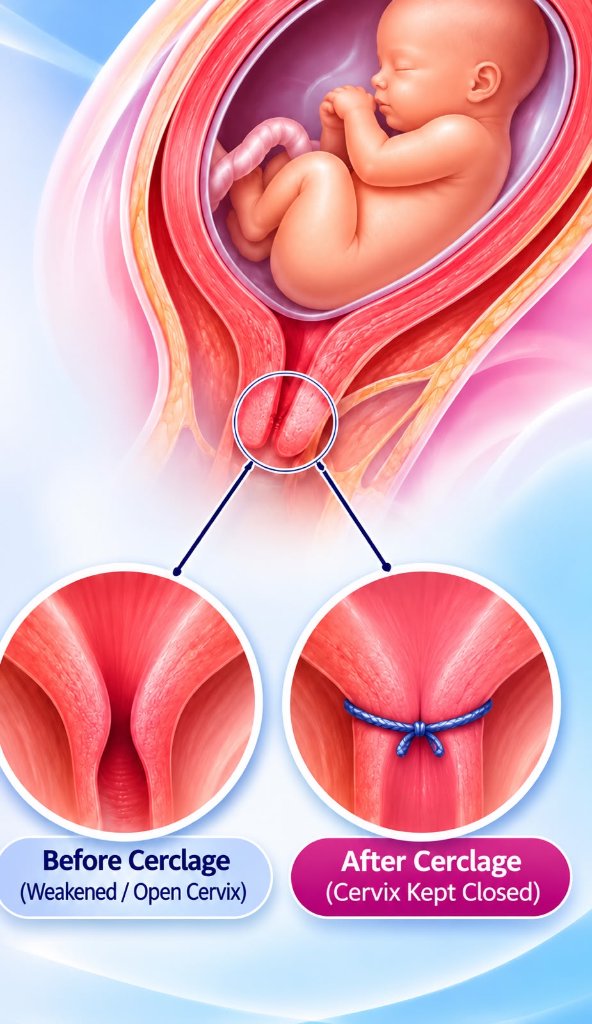
A cervical cerclage is a surgical procedure where an obstetrician places one or more stitches or a tape-like suture around the cervix to keep it closed during pregnancy and prevent early labor or miscarriage caused by a weakened cervix (cervical insufficiency)
1 Types of Cervical Cerclage
- Transvaginal Cerclage: The most common approach, where the stitch is placed by reaching through the vagina. Common techniques include the McDonald procedure (a purse-string suture placed around the cervix without dissecting tissue) and the Shirodkar procedure (sutures placed higher up near the base of the cervix).
- Transabdominal Cerclage: Performed through the abdomen (via open surgery or laparoscopy) if a transvaginal stitch failed in a previous pregnancy or if the cervix is too short to reach vaginally; requires delivery by Caesarean section
2 When and Why It Is Done
- History-indicated: Placed preemptively around 12–14 weeks of pregnancy if you have a history of second-trimester losses or preterm births.
- Ultrasound-indicated: Placed if a mid-trimester ultrasound shows a short cervical length (under 25 mm) combined with risk factors.
- Emergency (Rescue) Cerclage: Placed later in the second trimester if the cervix has already begun to dilate silently.
3 What to Expect During and After
- The Procedure: Usually performed as an outpatient procedure in a hospital or surgical center under regional (spinal/epidural) or general anesthesia. It typically takes 15 to 30 minutes
- Recovery: Mild cramping, spotting, or light bleeding can occur for a few days, which can be managed with approved pain relievers like acetaminophen. Most patients go home the same day.
- Removal: The stitch is typically removed around the 37th week of pregnancy (or earlier if your water breaks or labor starts) in a quick office visit. Transabdominal stitches are left in place and require a C-section for delivery
4 If you'd like more specific information, tell me:
- Why you are asking (are you currently considering a cerclage or looking back at a past procedure?)
- How many weeks pregnant you or the patient are